The right paper hand towel should dry hands efficiently, dispense one sheet at a time, and fit the intended dispenser without jamming or waste. Commercial buyers should compare towel format, folded and unfolded dimensions, GSM, ply, fiber furnish, wet strength, absorbency, and packing configuration. A cheaper carton is not always more economical: if users need several sheets per hand dry, consumption and refill labor can increase quickly.
Fold Types and Roll Formats
Paper hand towels are supplied mainly as folded sheets or rolls. The best format depends on traffic volume, dispenser design, available space, and the level of dispensing control required.
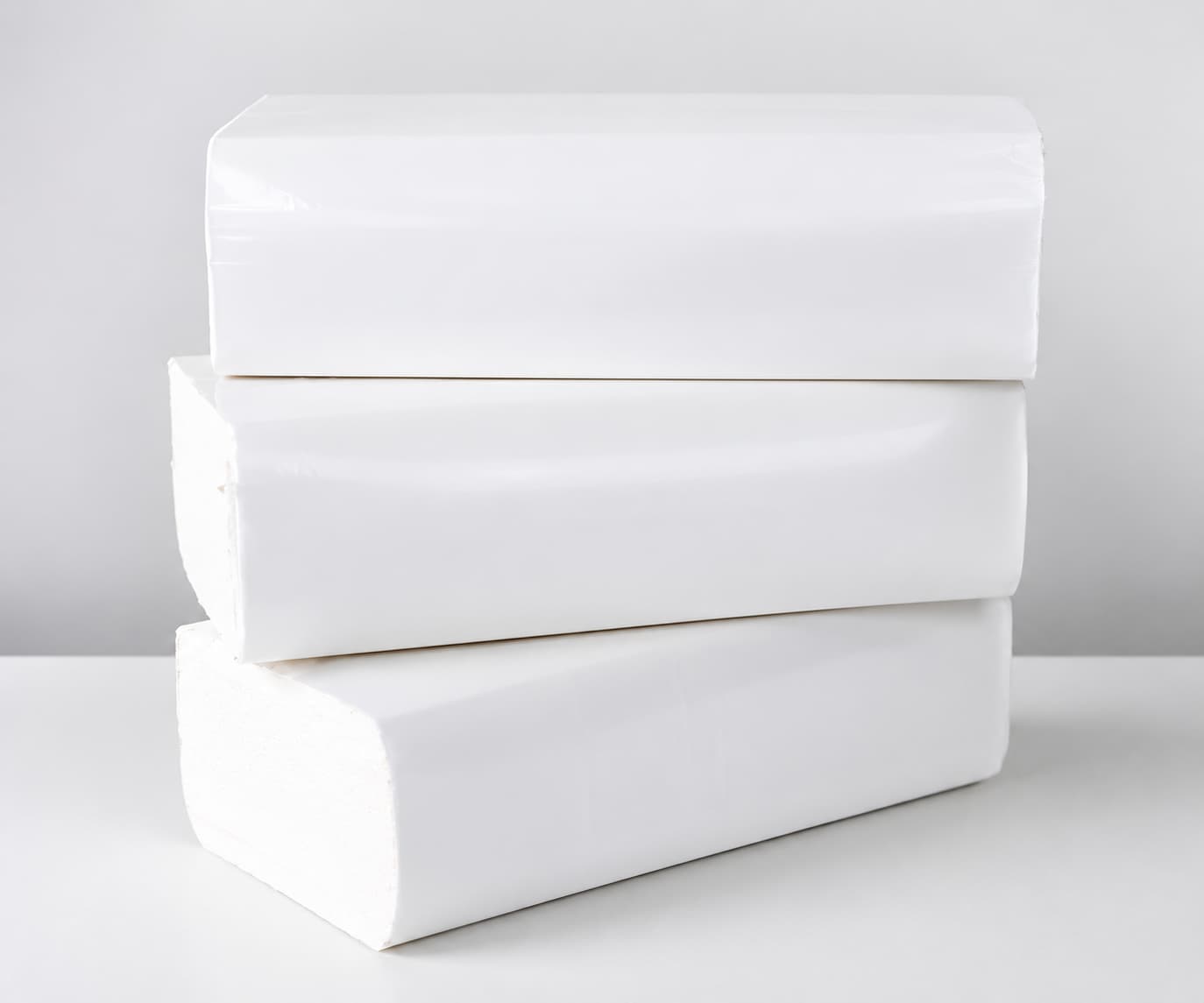
C-fold towels are folded inward from both sides. They are easy to stack, but the next sheet may not present automatically, so users can pull more than one. Z-fold or interfold towels overlap so that removing one towel presents the next. This supports one-at-a-time dispensing when the towel and dispenser are correctly matched. Terms such as multifold, M-fold, and V-fold vary between markets, so buyers should confirm dimensions rather than rely only on the fold name. Bi-fold and tri-fold towels are compact formats used in many wall-mounted dispensers. China Paper’s hand towel paper range includes roll, bi-fold, and tri-fold options for public and commercial hand drying. Hardwound rolls provide high capacity for busy washrooms and may be used with manual, autocut, or sensor dispensers. Roll width, outer diameter, core size, and paper stiffness must match the equipment.
Center-pull rolls dispense from the center and can suit workshops, food-service areas, and utility spaces. Their perforation and winding should support smooth, controlled pulling.
How GSM, Ply and Fiber Affect Performance
GSM means grams per square meter. It indicates sheet mass, but it does not measure total quality. Two products with the same GSM may differ in absorbency, softness, and wet strength because of fiber type, creping, embossing, bulk, and manufacturing process. A light hand tissue paper may look economical but tear when wet. A heavier sheet may feel substantial yet absorb slowly if its structure is dense. When comparing products from wet strength paper manufacturers, buyers should evaluate GSM together with absorption speed, wet tensile strength, and the number of sheets needed per use.
Ply is also only one part of performance. A well-made one-ply towel can work effectively when it has good bulk and an open fiber structure. A two-ply towel may feel softer, but weak ply bonding can cause separation during dispensing. Sample testing is therefore more reliable than choosing by ply count alone.
Virgin wood pulp is commonly selected for softness, brightness, and consistent appearance. Bamboo pulp can support a differentiated material option, while recycled fiber may suit procurement programs that prioritize recycled content. Environmental claims should be supported by recognized sourcing or ecolabel documentation, such as the European Commission’s EU Ecolabel criteria for tissue paper and tissue products. For premium applications, TAD technology uses through-air drying to preserve bulk and create a more open sheet structure. China Paper’s tad paper towels are available in specifications of 25–36 GSM and one to four ply, with water absorption above 9 g/g.
Good absorbency means more than holding water. Standardized laboratory evaluation may refer to ISO 12625-8:2010, which specifies a basket-immersion test method for measuring the water-absorption time and water-absorption capacity of tissue paper and tissue products. A commercial towel should take up moisture quickly, remain intact while wet, and provide enough usable surface to dry the hands comfortably.
A practical sample test should record:
Sheets required for one complete hand dry
Tearing, linting or ply separation
Ease of pulling the next sheet
Double dispensing or dropped towels
Performance when the dispenser is full and nearly empty
The most useful purchasing metric is often cost per hand dry, not price per carton. Divide the carton cost by the estimated number of effective hand dries. A more absorbent hand dry paper may cost more per sheet but less per use when one sheet replaces two weaker towels. Complete drying also supports hand hygiene. The CDC notes that germs spread more easily when hands are wet and recommends drying hands fully, whether paper towels or air dryers are used. Laboratory and food-related facilities should additionally follow local hygiene and building requirements.
Dispenser Compatibility Checklist
Dispenser mismatch is a common cause of jams, torn towels, and excess consumption. A towel may be absorbent but still perform poorly if the folded pack is too wide or the roll cannot feed correctly.
For folded paper hand towels, confirm:
Folded width and depth
Unfolded sheet size
Fold pattern and interfold direction
Sheets per pack and stack height
Dispenser opening width
Universal or format-specific design
For roll hand drying paper, confirm:
Roll width and maximum diameter
Core diameter and core type
Roll length or sheet count
Perforated or non-perforated format
Manual, lever, autocut, or sensor compatibility
Paper stiffness required for feeding
Do not approve an order from a product photo alone. Request a technical data sheet, physical samples, and a trial in the actual dispenser. Test under normal washroom humidity and with both a full and nearly empty dispenser. For workplace washrooms, the CDC Hand Hygiene Frequently Asked Questions also recommends providing an accessible way to dry hands, such as paper towels or a hand dryer. Hand towels should also be distinguished from wiping products. For cleaning counters, oil or food-preparation surfaces, kitchen towel paper may provide a more suitable structure than standard hand-drying tissue.
Hand Towel Paper Selection Table
| Application | Recommended Format | Main Priority | Compatibility Check |
|---|
| Office or school | Z-fold, multifold or tri-fold | Reliable dispensing and balanced softness | Folded size, stack height and opening |
| Mall or airport | Hardwound roll or high-capacity interfold | Capacity and low refill frequency | Roll diameter, core and cutting system |
| Hotel restroom | Soft interfold or TAD towel | Hand feel, absorbency and low lint | Sheet presentation and dispenser fit |
| Hospital or clinic | Single-use folded towel | Complete drying and controlled dispensing | Enclosed dispenser and local requirements |
| Restaurant | Interfold or controlled roll | Wet strength and fast uptake | Placement, refill access and relevant codes |
| Private-label program | Custom fold or roll | Stable GSM, dimensions and packing | Test against target-market dispensers |
FAQ
What GSM is best for hand towel paper?
There is no universal best GSM. The correct choice depends on sheet structure, ply, fiber, and absorbency. Compare GSM with wet strength and sheets used per hand dry.
Are Z-fold and multifold towels the same?
The terms are sometimes used interchangeably, but supplier definitions vary. Confirm the fold diagram and exact folded and unfolded dimensions before ordering.
Can roll towels fit any dispenser?
No. Roll width, outer diameter, core size, paper stiffness, and cutting method must match the dispenser, especially with autocut and sensor systems.
Is thicker hand dry paper always more absorbent?
No. Absorbency also depends on fiber structure, embossing, bulk, and production technology. A dense heavy sheet can absorb more slowly than a lighter, more open towel.
What should importers request before bulk purchasing?
Request the specification sheet, fold or roll drawing, GSM tolerance, material, ply, absorbency, and wet-strength data, packaging details, applicable certificates, and physical samples.
What hand towel options does China Paper provide?
China Paper offers conventional folded and roll hand towels, along with TAD Hand Towel products for buyers seeking higher bulk, absorbency, and wet strength.
References:
European Commission
https://environment.ec.europa.eu/topics/circular-economy-topics/eu-ecolabel/product-groups-and-criteria/paper_en
International Organization for Standardization
https://www.iso.org/standard/53425.html
Centers for Disease Control and Prevention
https://www.cdc.gov/clean-hands/faq/index.html
 English
 français
 Deutsch
 Español
 italiano
 русский
 português
 tiếng việt
 Türkçe
 العربية
 Indonesia