Introduction
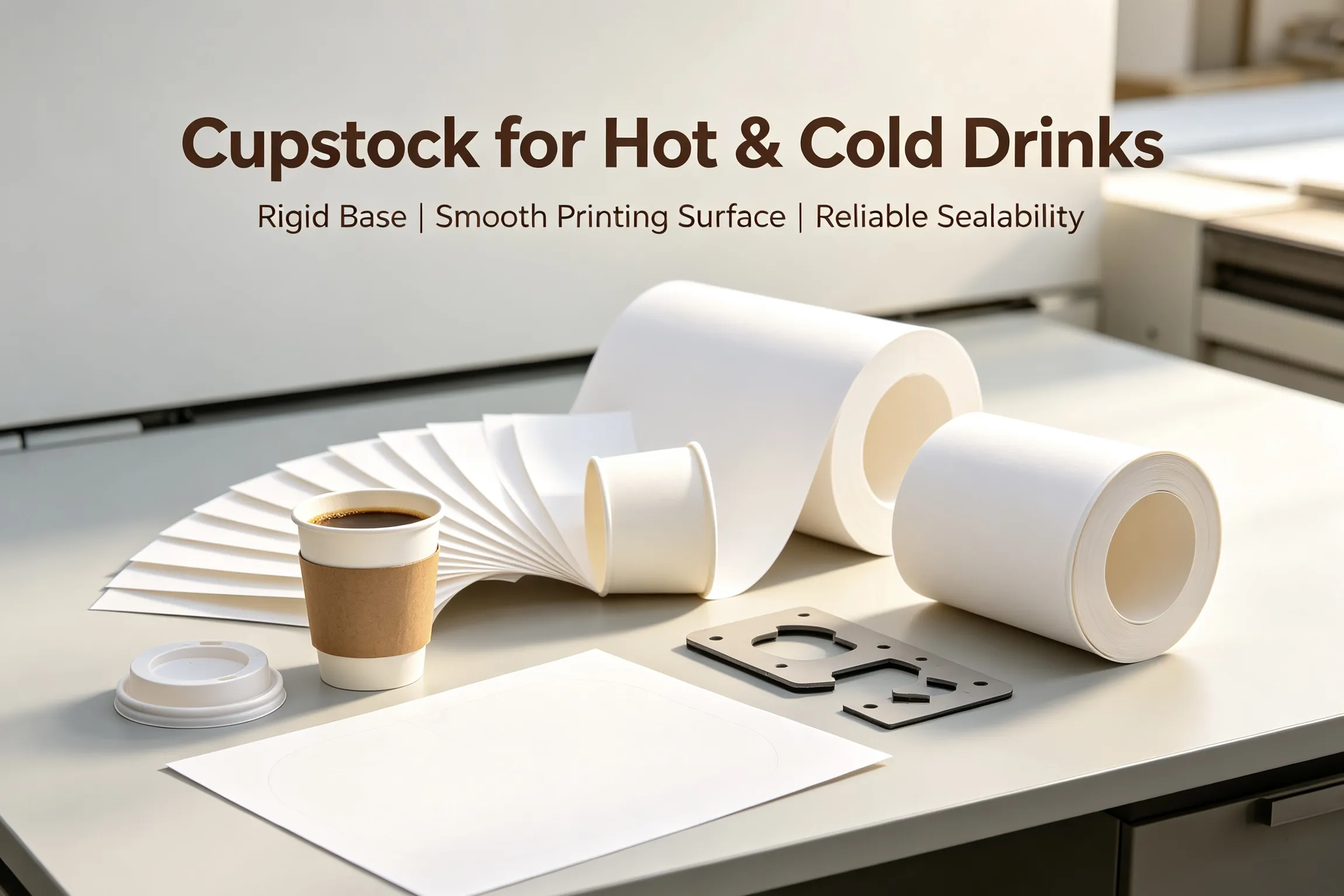
PE Coated Cupstock Paper is widely used in disposable paper cups and food packaging because it combines the strength and printability of paperboard with the moisture resistance and heat-sealing properties of polyethylene (PE).
However, during printing, die-cutting, cup forming, and final use, paper cup manufacturers may encounter problems such as leakage, delamination, curling, poor printing, and unstable cup forming. These problems can be influenced by both the cupstock paper and downstream processing conditions. Understanding the potential causes can help manufacturers improve production efficiency and final cup quality.
1. Leakage — Why Does a Paper Cup Leak?
Leakage is one of the most important concerns in paper cup manufacturing, especially for cups used for water, beverages, coffee, and other liquid products. One important factor is the PE coating. The PE layer acts as a barrier between the paperboard and the liquid. If the coating is too thin, uneven, or contains defects such as pinholes, the barrier performance may be compromised.
Common factors that may contribute to leakage include:
Insufficient PE coating weight
Uneven coating coverage
Pinholes or coating defects
Poor heat sealing
Incorrect sealing temperature or pressure
Improper cup-forming conditions
It is important to maintain a proper balance between PE coating weight, coating uniformity, and heat-sealing performance. A thicker coating does not automatically mean better performance; the coating needs to be suitable for the intended application and converting process. For manufacturers, consistent PE coating during production is therefore essential for achieving reliable moisture resistance and sealing performance.
2. Delamination — Why Does the PE Layer Separate from the Paper?
Delamination refers to the separation of the PE coating from the paperboard substrate. It can affect the appearance, converting performance, and barrier properties of the finished material. A strong bond between the PE layer and paperboard is important because the material may experience mechanical stress during die-cutting, printing, cup forming, and heat sealing.
Potential causes include:
Insufficient adhesion between PE and paperboard
Inappropriate paper surface characteristics
Inadequate surface treatment
Incorrect extrusion coating parameters
Contamination or dust on the paper surface
Improper storage conditions
The manufacturing process plays an important role in controlling this issue. The paper surface, surface treatment, PE extrusion coating conditions, cooling, and rewinding process all need to be properly controlled.Consistent bonding between the PE layer and paperboard helps maintain coating integrity throughout subsequent converting processes.
3. Curling — Why Does PE Coated Cupstock Paper Curl?
Curling is another common issue that can affect paper handling, printing, die-cutting, and cup forming. PE coated cupstock paper consists of different materials with different physical characteristics. Changes in moisture, temperature, coating stress, and web tension can influence the dimensional stability of the paper.
Several factors may contribute to curling:
1.Moisture Balance
Paper is sensitive to changes in moisture. Uneven moisture distribution between different areas or layers of the material can cause dimensional changes.
2.PE Coating Stress
The paperboard substrate and PE coating have different physical properties. Changes during coating and cooling may create internal stress and contribute to curling.
3.Web Tension
During coating, slitting, and rewinding, inappropriate tension control may affect the flatness and stability of the finished roll.
4.Storage Conditions
Temperature and humidity during transportation and storage can also affect the condition of PE coated cupstock paper.
Therefore, controlling paper moisture, coating uniformity, production tension, and storage conditions is important for maintaining dimensional stability.
4. Poor Printing — Why Does Ink Adhere Poorly?
Printing quality is particularly important for branded paper cups. Logos, product information, colors, and graphics need to remain clear and firmly attached to the surface. However, PE has relatively low surface energy, which can make ink adhesion more challenging if the coating surface is not properly prepared.
Possible causes of poor printing performance include:
Low surface energy
Insufficient surface treatment
Poor compatibility between ink and PE surface
Incorrect printing parameters
Contamination on the paper surface
Improper drying conditions
Surface treatment can improve the surface characteristics of PE and help provide better conditions for ink adhesion. For paper cup manufacturers, selecting cupstock paper with suitable surface properties and matching it with the appropriate printing ink and process can help achieve more consistent printing quality.
5. Poor Cup Forming — Why Is Cup Forming Unstable?
Even when the PE coating performs well, the overall paperboard properties can affect the cup-forming process.A paper cup needs sufficient strength and stiffness to maintain its shape while remaining suitable for high-speed forming and sealing.
Several paper properties are important:
| Paper Property | Importance in Cup Manufacturing |
|---|
| Stiffness | Helps the finished cup maintain its shape |
| Formation | Supports a consistent and uniform paper structure |
| Moisture | Influences dimensional stability during processing |
| Thickness | Affects forming and sealing performance |
| PE Coating | Provides moisture resistance and heat-sealing performance |
| Tensile Strength | Helps reduce cracking and breakage during forming |
Poor cup forming may also be related to equipment settings, forming speed, temperature, tooling, and other downstream processing conditions.Therefore, reliable cup forming requires a balanced combination of paper strength, stiffness, formation, moisture, thickness, and PE coating performance.
Conclusion
The performance of PE Coated Cupstock Paper can directly influence the efficiency of paper cup manufacturing and the quality of finished cups. Problems such as leakage, delamination, curling, poor printing, and unstable cup forming can have different causes, and not all issues are related solely to the paper material. Paper properties, PE coating performance, converting equipment, processing parameters, and storage conditions can all play a role.
For paper cup manufacturers, choosing a reliable cupstock paper supplier with consistent manufacturing and quality-control capabilities is an important step toward achieving stable production.
China Paper provides PE Coated Cupstock Paper in roll form for paper cup and food packaging applications, supporting customers with stable paper quality and reliable supply.
 English
 français
 Deutsch
 Español
 italiano
 русский
 português
 tiếng việt
 Türkçe
 العربية
 Indonesia